The night before your smog check appointment, you’re probably wondering: “What exactly do I need to bring?” It’s a simple question, but getting it wrong means wasting time at the appointment or having to reschedule.
Here’s everything you need to know about documentation and preparation for your California smog check appointment.
The Essential Documents (You Absolutely Need These)
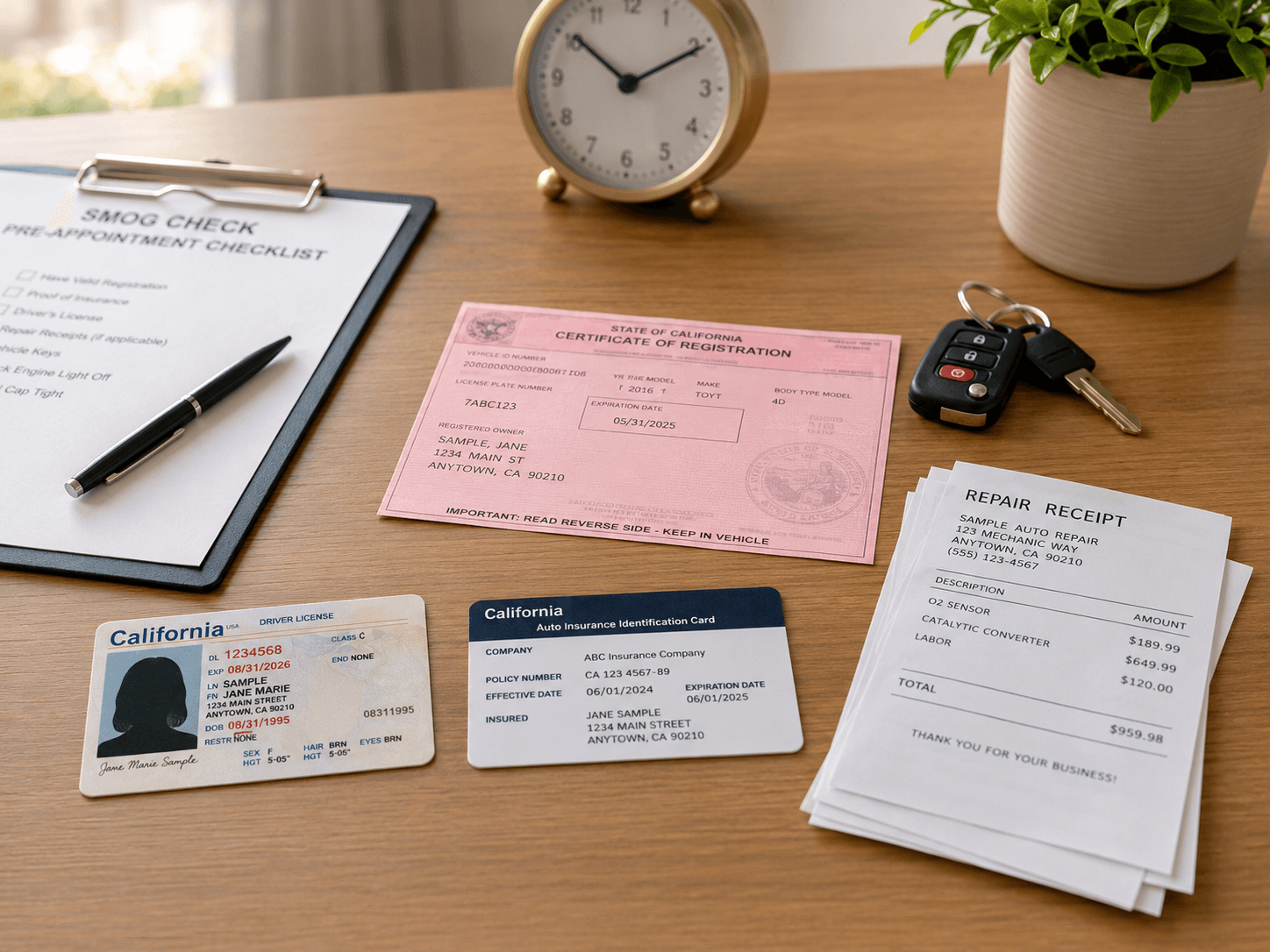
1. Your Vehicle Registration (Pink Slip or Certificate of Registration)
This is non-negotiable. You cannot take a smog check without current vehicle registration documentation.
What counts:
- The physical pink slip (Certificate of Registration) from your DMV
- A temporary registration if yours is expired (but you can’t test with an expired registration that you’re not actively renewing)
- Digital registration on your phone (California now allows this)
What doesn’t work:
- An expired registration from 2+ years ago
- Just the registration card (you need the full document)
- A printed email confirmation
Pro tip: If your registration is expired, contact your local DMV before scheduling a smog check. You may still be able to renew, but you’ll need to understand the process. Some people try to renew registration online and think they’re cleared for smog; they still need to complete the DMV appointment.
2. Your Driver’s License or Valid ID
Bring one photo ID. This confirms your identity and your legal right to authorize the smog check on your vehicle.
What works:
- California driver’s license
- California state ID card
- Passport
- Military ID
- Any other government-issued photo ID
3. Proof of Current Insurance
California technically doesn’t require proof of insurance for the smog check itself, but your vehicle must be insured to be registered legally. Some stations request proof of insurance before testing to ensure you’re not trying to register an uninsured vehicle. Bring it to be safe.
What works:
- Insurance company card (digital or physical)
- Insurance confirmation email on your phone
- Insurance bill showing current coverage dates
- Screenshot of your insurance company’s app
That’s it. That’s technically all you legally must bring to pass a smog check.
However, there are additional items that make the process smoother.
Helpful (But Optional) Documents
Your vehicle’s service records
Not required, but helpful if:
- Your vehicle recently failed a smog check (bring repair receipts so the technician knows what was fixed)
- You’ve recently had major work done (new catalytic converter, O2 sensor, engine work, etc.)
- Your vehicle is very old and you want the technician to know about recent maintenance
What to bring:
- Repair invoices showing what was repaired
- Oil change records
- Recent maintenance receipts
Why it helps: The technician can see that repairs were completed and will have confidence that your vehicle has been properly maintained. This is especially helpful after a previous failure.
Your vehicle’s title or proof of ownership
Not required for the smog check itself (registration proves you’re the registered owner), but bring it if:
- You’re preparing to sell your vehicle and need the smog certificate for title transfer
- You’re planning to donate your vehicle and need documentation
- Your registration is brand new and you want to confirm everything is aligned
Previous smog check certificates (if you have them)
Completely optional. Technicians don’t need your history to perform a new test. However, some people like to bring their last few certificates to show historical compliance, especially if they’ve never failed before.
Documents You DON’T Need (But People Often Worry About)
Maintenance records for routine oil changes Not needed. Your vehicle’s current condition is what matters.
Emissions testing receipt from another state Not relevant. California tests to California standards.
A passing smog certificate from 2+ years ago This doesn’t matter. You’re testing for your current renewal, not relying on past passes.
Repair estimates or quotes Only needed if your vehicle failed a previous test and you’re providing documentation that repairs have been completed.
The Day Of Your Appointment: Preparation Tips
Arrive 10-15 minutes early
This gives you time to:
- Complete any paperwork (usually minimal or digital)
- Answer the technician’s initial questions
- Relax before the actual test
Have your documents organized and ready
Don’t make the technician ask for them. Have your registration and ID in hand when you check in.
Turn off your radio and phone notifications
Minimize distractions. The technician needs to focus on your vehicle, and you want a clean, professional appointment.
Don’t leave valuables visible in your car
While technicians are trustworthy professionals, it’s standard safety to keep your car looking empty of valuables during the test.
Common Documentation Questions
Q: Does the registration have to be in my name? A: Technically, the registered owner can authorize anyone to test the vehicle. However, it’s cleanest if you’re the registered owner or have written authorization from the owner. Most people testing their own vehicles are the registered owner, so this isn’t usually an issue.
Q: What if I just bought the vehicle and the registration is in the previous owner’s name? A: You need to update your registration at the DMV first. You cannot test a vehicle unless your name is on the registration (or you have the owner’s written permission). This usually happens before scheduling a smog check.
Q: Can I test my partner’s or family member’s vehicle? A: Yes, but you’ll need their written permission or they can authorize you with the registration in hand. It’s cleanest if the registered owner is present or calls ahead to let the station know authorization is granted.
Q: What if my registration is temporary or I just moved to California? A: Temporary registrations are fine for smog testing. If you just moved to California and transferred your registration, your new California registration (or temporary registration) is what you need.
Q: Does the registration have to match the vehicle identification number (VIN)? A: Yes. The technician will cross-reference your registration with your vehicle’s VIN. They must match. If they don’t, you have a registration error that needs to be corrected at the DMV before testing.
Q: Can I test my vehicle if my driver’s license is expired? A: Your driver’s license doesn’t need to be current for a smog check; the smog test is on the vehicle, not the driver. However, you do need a valid form of ID (passport, military ID, state ID card, or current driver’s license).
Q: What if I don’t have my physical registration card? Can I use my digital registration from my phone? A: California now allows digital vehicle registration through the CA DMV app. If you have your vehicle registered digitally, you can show that on your phone instead of a physical card. However, confirm with your testing station that they accept digital registration (most do).
Special Situations
Testing a newly purchased vehicle Bring:
- Your new registration
- Your ID
- Proof of insurance
- Proof of recent ownership transfer (bill of sale or DMV paperwork) – optional but helpful
Testing after repairs (smog check retest) Bring:
- Your registration
- Your ID
- Proof of insurance
- Your repair receipts or invoice showing what was fixed
The technician will use the repair documentation to understand what’s been addressed since your last failed test.
Testing an out-of-state vehicle for the first time Bring:
- Your recently updated California registration
- Your ID
- Proof of insurance
- Your out-of-state title (optional but helpful)
Testing a commercial or fleet vehicle Bring:
- Business registration or proof of business ownership
- Vehicle registration (should be in business name)
- Company-authorized representative’s ID
- Fleet maintenance records (optional but helpful)
Before Your Appointment: Your Checklist
Use this to prepare the night before:
- Locate your vehicle registration (pink slip)
- Find your valid photo ID (driver’s license or other)
- Find your current proof of insurance
- If retesting after failure, gather repair receipts
- Confirm your appointment date and time
- Confirm the testing station’s address and parking situation
- Plan to arrive 10-15 minutes early
- Fill your fuel tank the night before (helps with EVAP system testing)
- Give your vehicle a 30-minute highway drive (helps with engine warm-up)
At AB Smog Check: We Keep It Simple
Our goal is to make your smog check appointment as smooth and stress-free as possible. We’ll let you know exactly what we need, guide you through the process, and explain your results clearly.
Most people overthink what to bring. Bring your registration, ID, and proof of insurance, and you’re 99% of the way there. We’ll handle the rest.
Come prepared, stay organized, and your smog check will be quick and painles