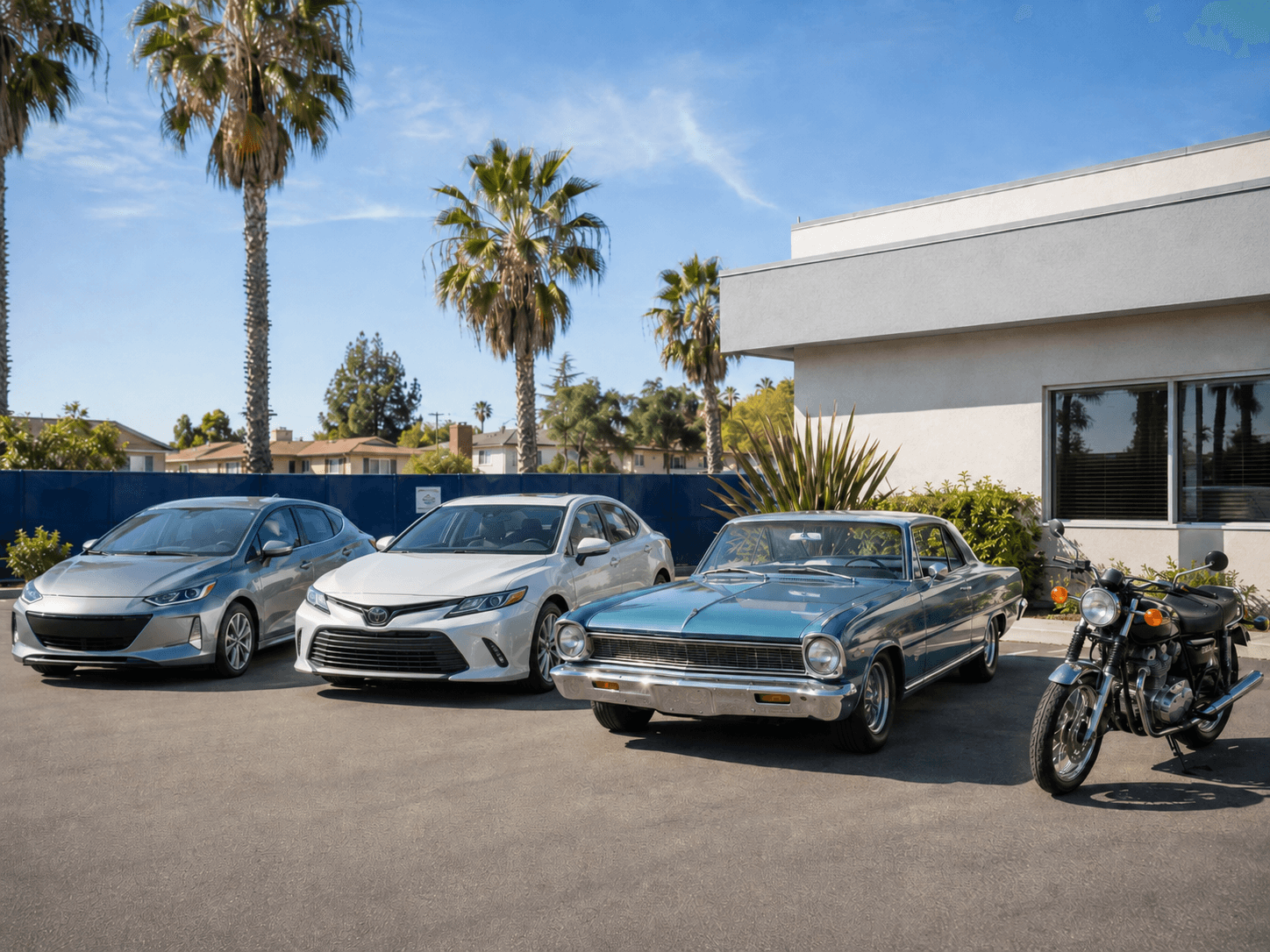
Most gasoline, hybrid and alternative-fuel vehicles from model year 1976 and newer need a smog check in California. So do diesel vehicles from model year 1998 and newer that weigh under 14,001 pounds. Electric vehicles, motorcycles and very old vehicles do not, and newer vehicles get a break for their first several years.
The right answer for your car depends on its model year, its fuel type and what you are doing with it, whether that is renewing, selling or registering it for the first time. This guide sorts those out so you can find your vehicle quickly.
A Quick Guide by Vehicle Type
| Vehicle | Smog check needed? |
|---|---|
| Gasoline, model year 1976 and newer | Yes, with age-based breaks explained below |
| Hybrid and alternative-fuel, model year 1976 and newer | Yes, same rules as gasoline |
| Diesel, model year 1998 and newer, under 14,001 lbs GVWR | Yes, with the same age-based breaks |
| Natural gas or propane, under 14,001 lbs GVWR | Yes |
| Gasoline, hybrid and alternative-fuel, model year 1975 and older | No |
| Diesel, model year 1997 and older | No |
| Diesel over 14,000 lbs GVWR | No |
| Fully electric vehicles | No |
| Motorcycles | No |
These categories come from the Bureau of Automotive Repair and the DMV. If your vehicle sits on the edge of one of them, confirm it before you skip the test.
How Model-Year Breaks Work
Age changes the answer in three different ways, and it helps to keep them apart.
For registration renewal, eight model years. Vehicles eight model years old or newer do not need a smog check to renew their registration. Owners pay a smog abatement fee instead. When a car ages out of that window, the two-year test cycle begins. In 2026, the 2018 model year is the first to lose the exemption, which we explain in 2026 California smog rules.
For a change of ownership, four model years. Vehicles four model years old or newer do not need a test when they are sold. Older vehicles generally need a passing certificate from the seller, and for a private sale it must have passed within the last 90 days. If you are selling, can you sell a car without a smog check in California covers the details.
For a first registration in California, no age shortcut. BAR says a smog check is required to register a vehicle for the first time in California, including one previously registered in another state. The eight-year and four-year rules do not simply carry over, so read do out-of-state vehicles need a smog check in California before you assume your car qualifies.
If you want the timing side of this, how often you need a smog check covers the two-year cycle.
Hybrids and Electric Vehicles
Fully electric vehicles are exempt, because they have no tailpipe emissions. Hybrids are a different story. They have a gasoline engine, so they follow the same model-year rules as a standard gasoline car. The idea that hybrids are exempt is one of the most common smog check myths. Our post on smog checks for hybrid vehicles explains what to expect at the test.
Diesel Vehicles
Diesel vehicles from model year 1998 and newer with a gross vehicle weight rating under 14,001 pounds need a smog check, and diesel hybrids are included. Older diesels from model year 1997 and earlier are exempt, and so are diesels over 14,000 pounds. For the testing side, see diesel vehicle smog checks in California.
Older and Classic Vehicles
Gasoline, hybrid and alternative-fuel vehicles from model year 1975 and older do not need a smog check. The cutoff is the model year printed on your registration and title, not the date the car was built or the date you bought it. Vehicles from 1976 and newer are in the program no matter how rare or well kept they are. Our guide to smog check exemptions and waivers covers the less common cases.
What If Your Vehicle Has Failed a Smog Check?
A failed test does not exempt you from anything. A vehicle that needs a smog check still needs a passing result, so you repair the problem and retest. What to do if your vehicle fails a smog check covers the next steps.
A small group of failures are serious enough to get a special label. A gross polluter is a vehicle whose emissions exceed the standard limits by a wide margin, and it faces tighter rules on repairs and retesting. Our post on what a gross polluter is in California explains the process. If repair costs are the problem, California’s Consumer Assistance Program for smog repairs may help eligible owners.
How to Confirm Whether Your Vehicle Needs a Test
Start with your DMV registration renewal notice, which states whether a smog certification is required for that renewal. Some notices also say you must use a STAR-certified station, and what a STAR station smog check is explains what that means.
For anything the notice does not answer, check the Bureau of Automotive Repair’s smog check page or ask the DMV directly. You can also look up your car’s past tests with the free tool in our guide to checking your vehicle’s smog check history. If a test turns out to be due soon, what to do if your vehicle is due for a smog check soon walks through the steps.
What the Smog Check Involves
The test has a visual inspection, a check of the emissions components, and an emissions test. Newer vehicles are mostly checked by reading their onboard computer, while older vehicles may need a tailpipe test, which takes longer. A lit check engine light will fail the test. What a smog check looks for breaks down each part, and what happens during a smog check inspection follows a typical visit from start to finish.
Frequently Asked Questions
Do hybrids need a smog check in California?
Yes. Hybrids follow the same model-year rules as gasoline vehicles. Only fully electric vehicles are exempt.
Do electric vehicles need a smog check?
No. Fully electric vehicles are exempt.
Does a new car need a smog check?
Not for renewals during its first eight model years, and not for a change of ownership within its first four. A car new to California from another state follows the first-registration rule instead.
Is a 1975 car exempt?
Yes. Gasoline, hybrid and alternative-fuel vehicles from model year 1975 and older are exempt.
Do diesel trucks need a smog check?
Diesel vehicles from 1998 and newer under 14,001 pounds gross vehicle weight rating do. Heavier diesel vehicles are exempt.
Do motorcycles need a smog check?
No. Motorcycles are exempt.
Get Your Smog Check at AB Smog Check in Monterey Park
If your vehicle needs a test, our STAR-certified station handles both regular and STAR-required vehicles, so you only need one stop. You get a plain explanation of your result, and if you are not sure whether your car is covered, we are happy to help you figure it out before you pay for a test.
AB Smog Check 501 E Garvey Ave, Monterey Park, CA 91755 Phone: 626-280-2678
Hours: Monday to Friday, 9:00 am to 5:00 pm Saturday, 9:00 am to 3:00 pm Sunday, closed
No appointment necessary. Pass or have a free re-test.